Design brief concept
The approach to interbeing should be related to the link between the artist’s freedom to serve as the channel for spiritual instinct which is the source of the art piece, and the visitor’s ability to use their perception channel as the receptor for the artist’s channel. The joining of their channels opens up the communication with the universal and spiritual, which permeates everything and everyone, and therefore the opportunity to keep the universal and spiritual alive in the awareness of the visitor when the contact with the art piece is over, which is an opportunity for the visitor to keep recognising and supporting the universal and spiritual in their own everyday life.
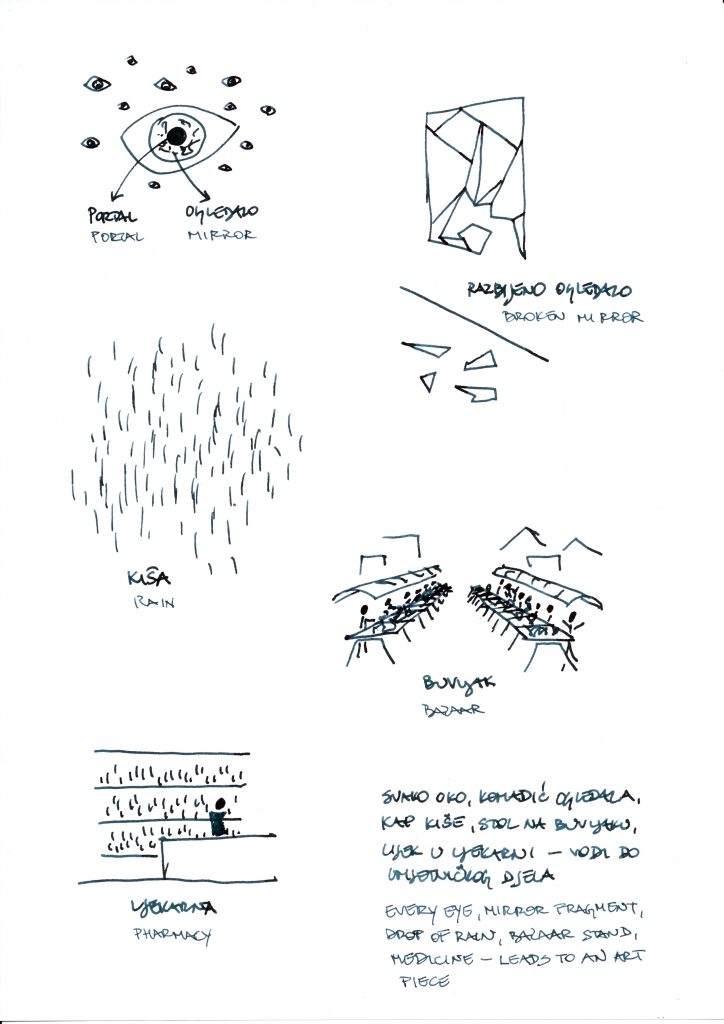
The primary space of the museum should be abstract, without concrete forms from the nature or human artefacts, and without the usual limitations of movement through physical space. From this space, one can enter the space of an art piece, whether that means that a video is activated, or an image shown, or that one finds themselves in a space that contains a virtual wall with a painting, or in a space with a 3d model of a sculpture, or in an interactive animation. (…) Whether the art piece is on its own in its space or together with other pieces, depends on the curatorial concept, and the curator can be a person commissioned to curate a specific “exhibition,” or the artist, or a group of artists, or the visitor… This depends on the decisions made by the manager of the virtual museum and the interface that determines or enables the kinds of interactions.
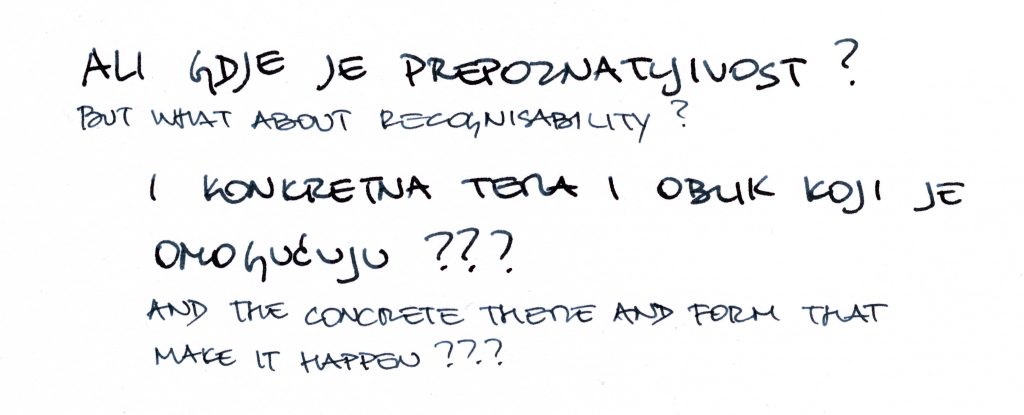
The arrival into the primary, abstract space should enable the transition from the everyday mind frame into a state that is simultaneously more meditative and active, where the human being isn’t as distracted and passive as they usually are, especially when engaging digital interfaces. The transition should include introspection, exposure, jumping into the unknown, contact with the infinite and abstract, playful curiosity and a step into exploration.
The human being should be alone in that space and in communicating with an art piece, just like one is alone in a spiritual sense, but should also be aware of the presence of other visitors who want to communicate with art pieces, just like one is not alone in a spiritual sense.
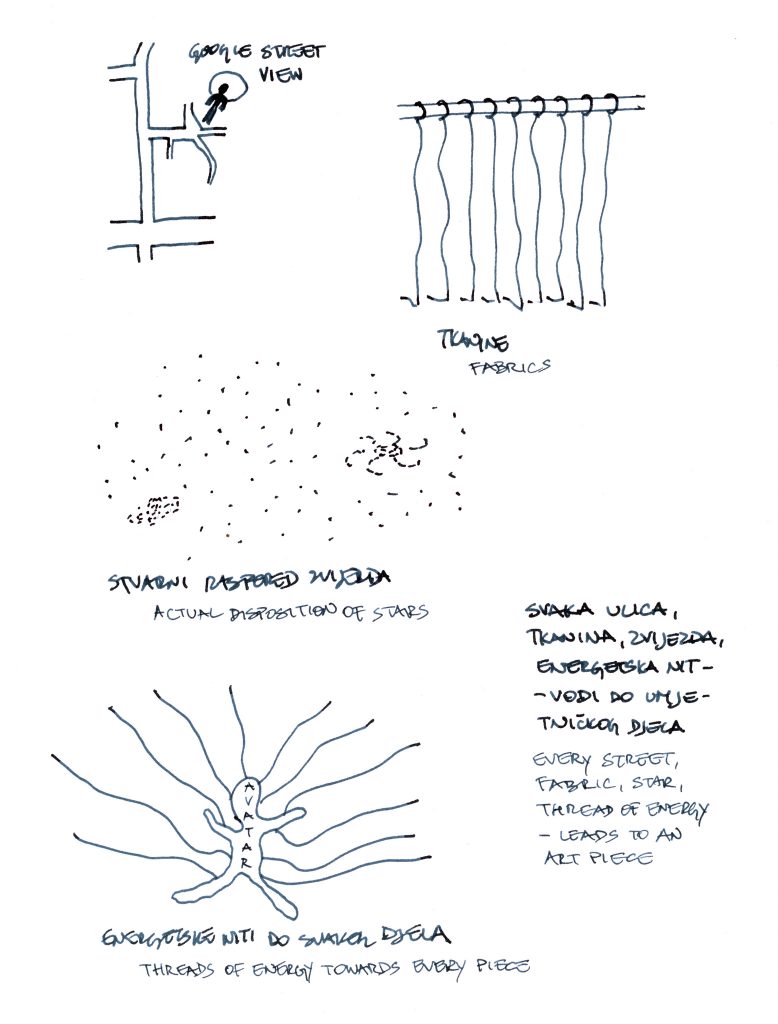
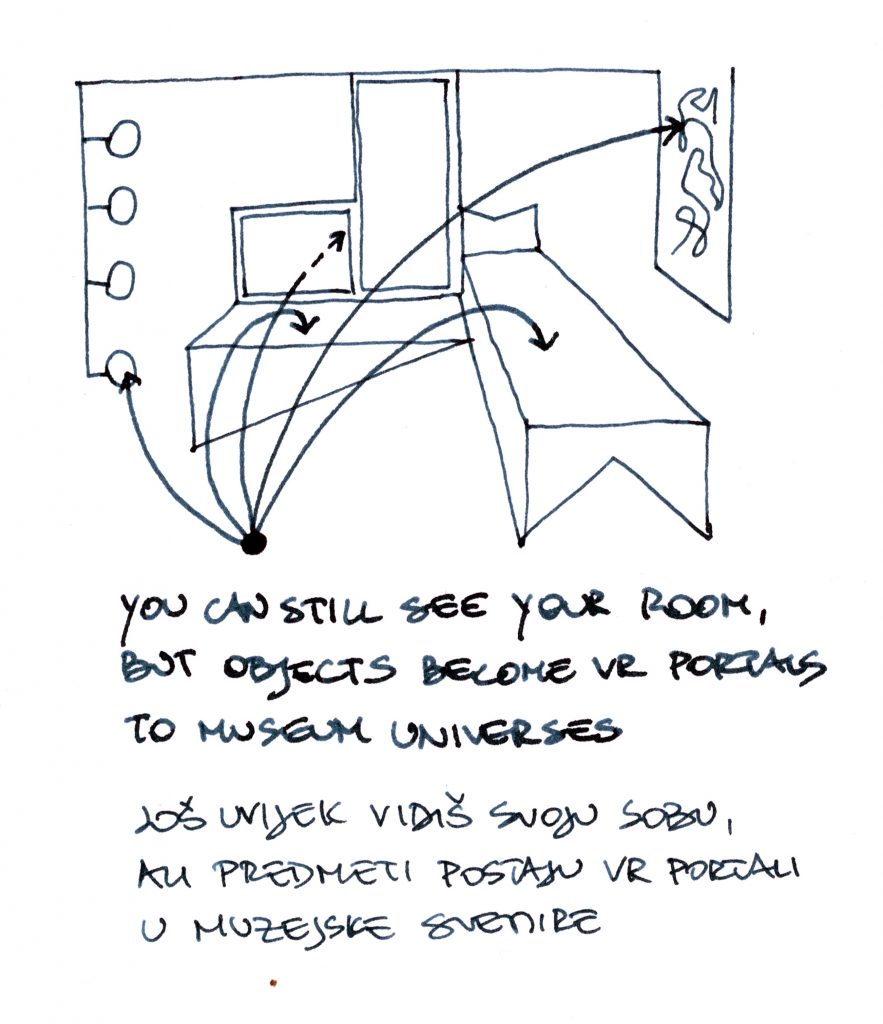
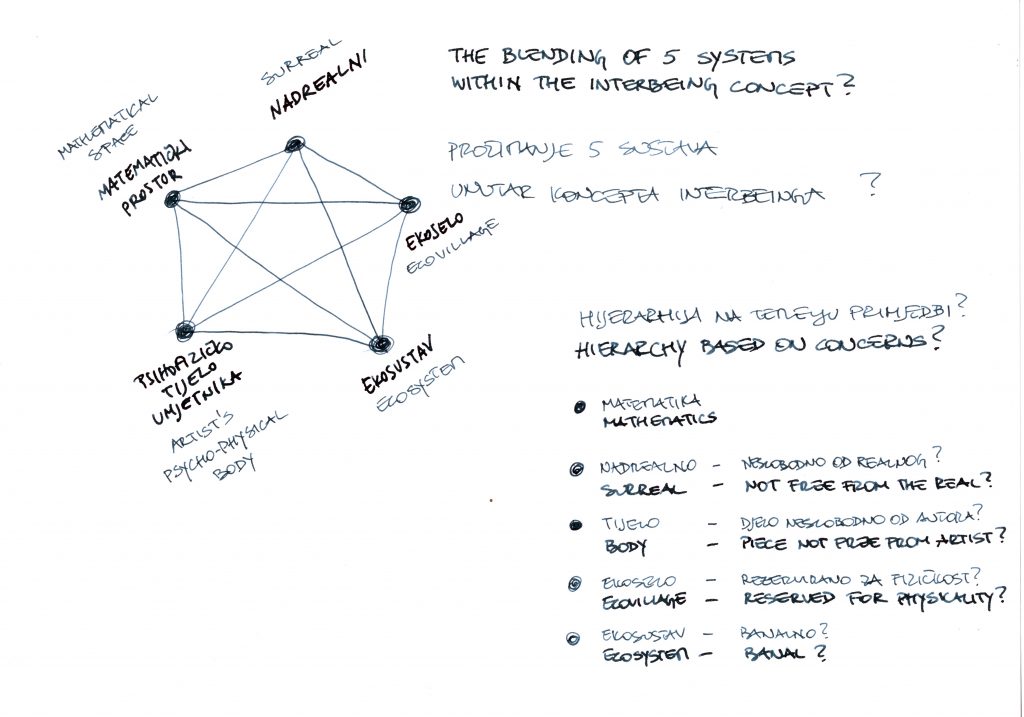
To sum up, we identified three different spaces for the virtual museum: (1) the space of transition from the usual reality; (2) the abstract space with “doors” into the spaces of art pieces; (3) the spaces of art pieces. All three spaces are interactive in their own ways. The first two spaces would be constant, while the third space (spaces) would be designed according to the needs of art pieces and curatorial concepts, and their number would probably increase over time.
First, the visitor arrives to the transition space. It’s a space close to the water. It can be loaded, without the visitor’s ability to influence the loading, as a sand or pebble beach, a cliff edge, a rocky shelf, the bank of a river or stream, and so on. But the water isn’t there. The edge of the beach/cliff/bank is the last thing one can see before the nothingness begins. Or the “somethingness.” The visitor realizes that they may “enter” the “water,” but they can’t actually do it before they visit the changing cubicle. The cubicle was also randomly loaded and is one of a variety of designed versions, each one different in terms of exterior and interior appearance. What they have in common is that in each one the visitor is presented with one or more randomly generated questions. Each possible question is intimate, encouraging the visitor towards introspections, sincerity with themselves, being exposed. The visitor can, of course, enter an insincere or meaningless response, but the question still happened in their awareness. Only when a response is given, can the visitor leave the cubicle and jump into the “water,” which doesn’t look like water, but like infinity. The visitor jumps into infinity.
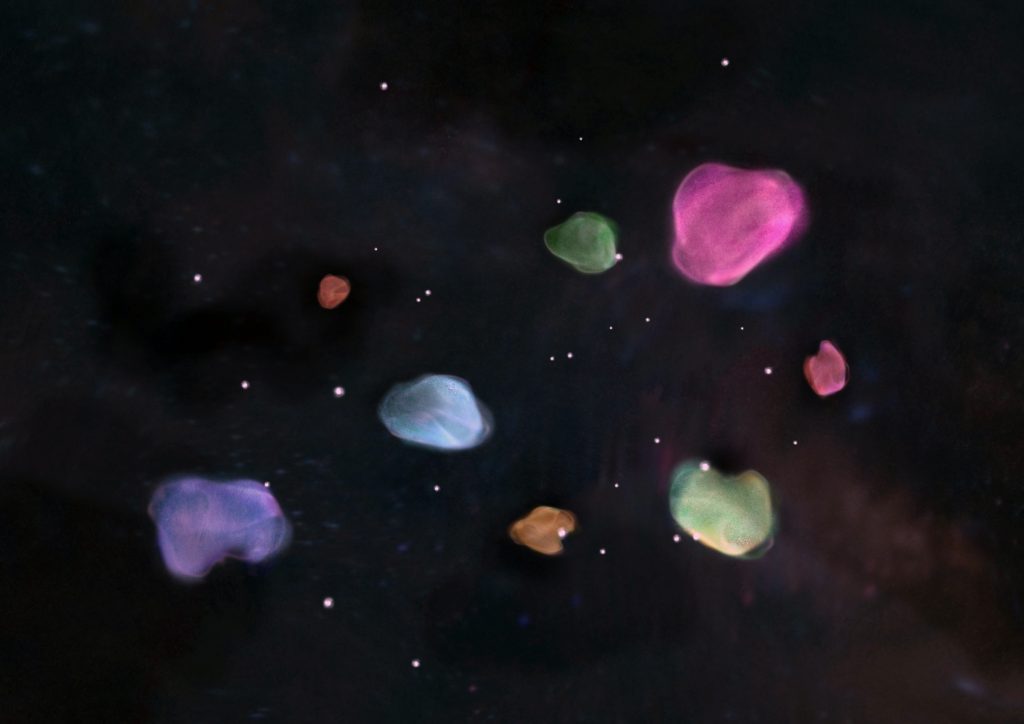
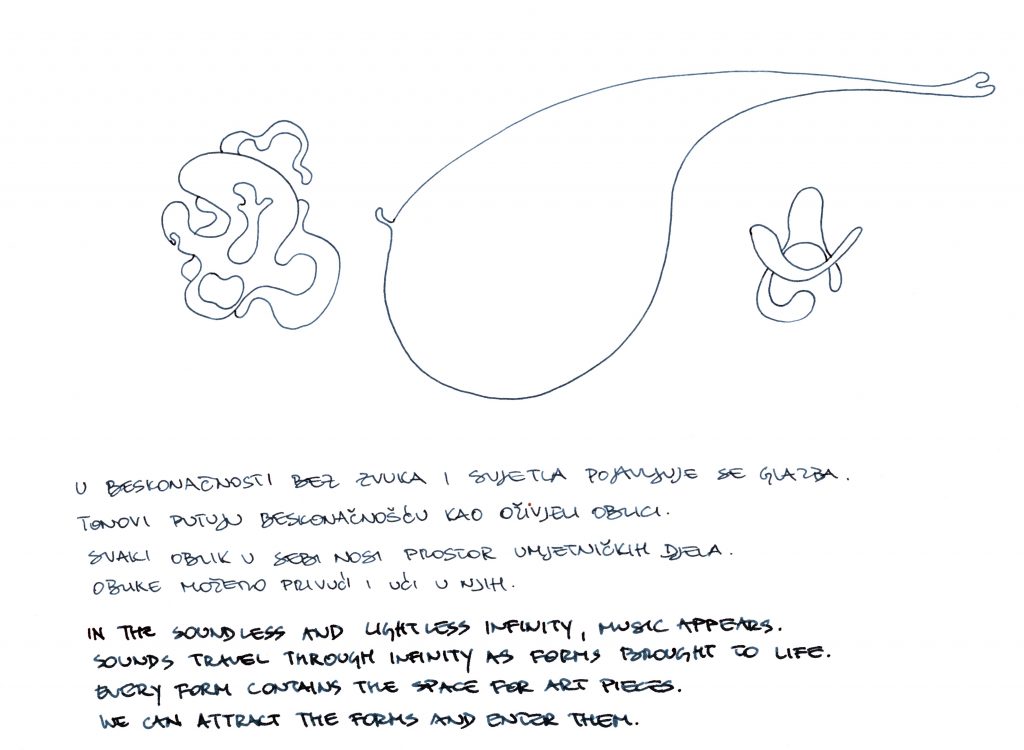
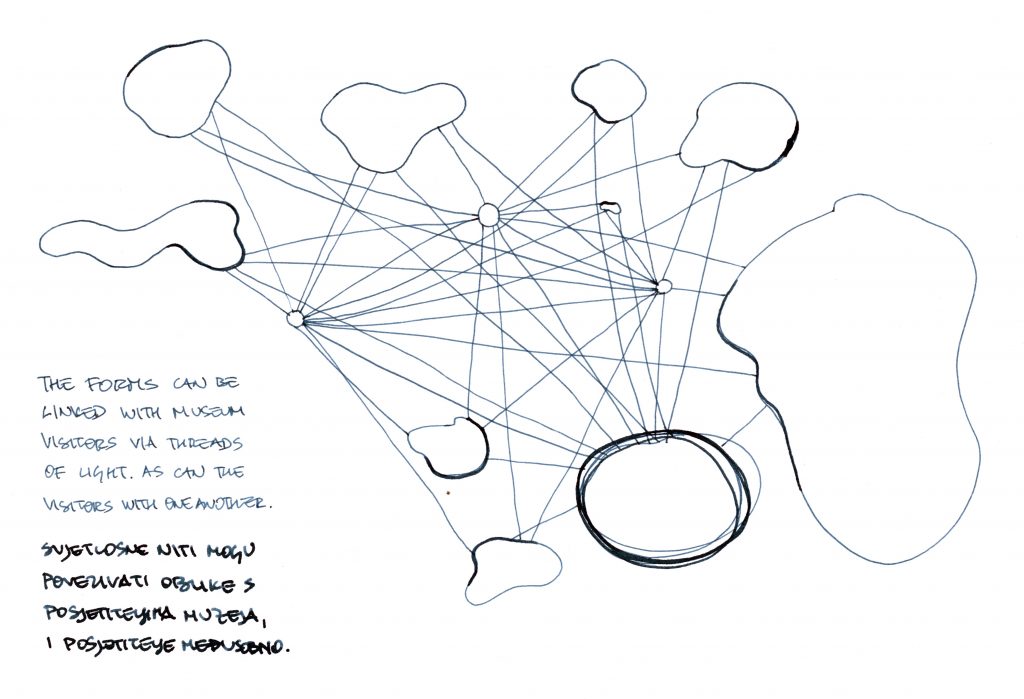
Once in infinity, gravity no longer holds. We are surrounded by moving blobs of different shapes, sizes and colours, each with their own sound, and we can move between them in all directions. Furthermore, we can reach a blob and enter it. What happens next, depends on the artist and the curator, but in any case, we’ll reach the (space of an) art piece. The blob shapes are primarily luminous, without clear boundaries and sharp edges.
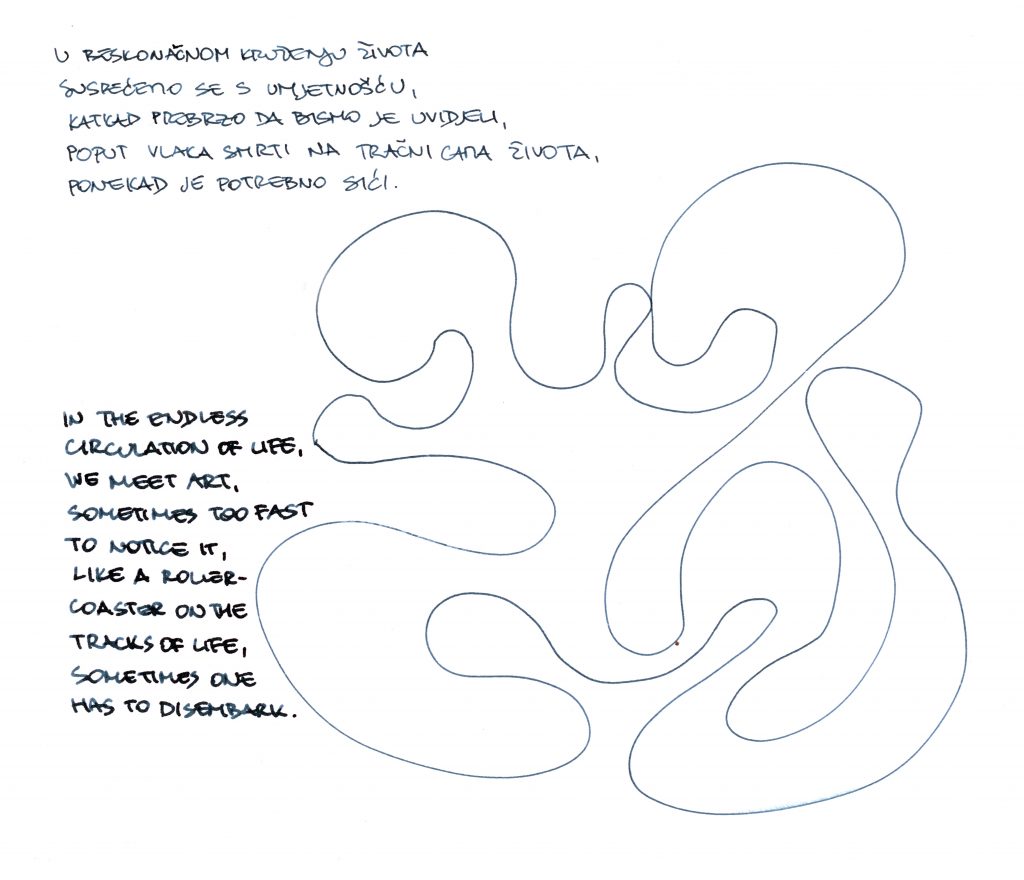
The tone of a blob can be recognisable by its frequency (pitch), timbre (instrument), oscillations of dynamics (volume) and rhythm. The overall dynamics of the sound can be increased as we approach the blob and decreased as we move away from it. The tones can be composed so that the overall soundscape of the infinity harmoniously comprises different blob-tones, but without the overall coherence typical of music pieces (compositions), which don’t readily yield themselves to further developments, meaning they aren’t “open” in a way that fits the needs of a space with an increasing number of blobs.
In the infinite space, we can see all other visitors currently in it, but only as small points of light between and beside the blobs.
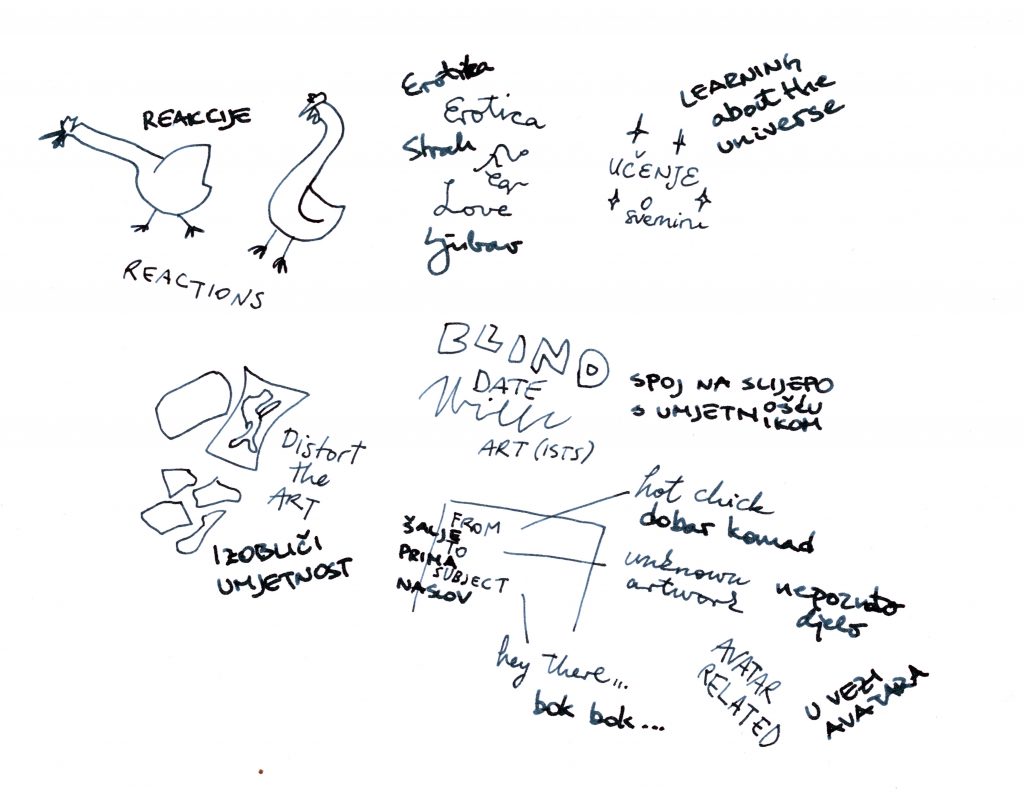
We can’t interact with them, but we know we aren’t alone. It could be really neat to be waiting in a crowd of luminous points, in front of a blob whose art piece’s “exhibition opening” is due in a few minutes, so we can’t enter yet, but are hype with anticipation, all in silence, without the possibility for trivial weather talk or the like. We can, however, interact with other visitors when we leave the virtual museum. In a space for “grabbing a drink,” “hanging out” … In other words, we suggest that there be another “address,” dedicated precisely to sharing experiences, talking, lectures, promotions, arranging group visits… We propose that the place be dedicated to fire, i.e. to connecting around the fire, something out of which human social nature and community power developed. In a way, this complements the panta-rei infinity of water we experienced in the (ante-)space of the museum.
The space of the museum thus remains a place of connecting to ourselves, through art, as well as to spirituality, truth. It therefore facilitates transformation, free from the intellectualisations of everyday life, of comments, judging/judgements, manifestations of one’s ego and exposure to other egos.
For one to get around more easily, there is a “navigation blob,” where, like in the flight control space, one can see the movement of all the blobs and search them by various parameters. (…)
“Architecturally,” design and modelling are needed for the space and form of the cubicles, the space of the beach and the forms of the blobs. At the other address, the space around the fire is needed.
(…)